A range of different newspapers are every day in the UK, these include national, local and Sunday editions. In the past, newspapers were mainly categorised by their size – tabloids and broadsheets – however, although these terms are still used, they are no longer accurate, as newspapers over the years have experimented with different sizes and designs in order to attract a diminishing readership and to address’ needs.
Tabloid newspapers used to be the popular press and broadsheets were quality newspapers – referring to the style of news they carried. Newspapers can now be divided into three groups:
Quality Newspapers – previously known as broadsheets, for example the Guardian and The Times.
Middle market tabloids – made up of the Daily Mail and the Express.
Red tops – named such as their mastheads are presented in red – for example the Sun.
Who owns the press?
It is important to be aware of the significance of patterns of ownership and their impact upon the production and distribution of your set newspaper. The biggest player in the newspaper industry is News Corporation owned by Rupert Murdoch. His media empire owns the Sun, The Times, The Sunday Times, and the Sun on Sunday. Other main newspapers are owned by:
The i: Alexander Lebedev’s Independent Print Limited
The Guardian and the Observer: Scott Trust Limited
The Daily Mirror, the Sunday Mirror and the People: Trinity Mirror
Daily Express, Sunday Express, Daily Star, Daily Star on Sunday: Richard Desmond’s Northern and Shell
Daily Telegraph and the Sunday Telegraph: Press Holdings owned by the Barclay Brothers
The Daily Mail and the Mail on Sunday: Lord Rothermere’s Daily Mail and General Trust plc
The newspaper industry is very powerful and as you can see, is largely in the hands of a few powerful media groups and individuals. Although sales of print newspapers are falling, the front page of a newspaper is still an important vehicle to target messages to audiences.
Newspaper Ownership
Owen Jones
Owen Jones, a journalist and political activist, said the press is:
‘Largely run by a very small group of very right wing media moguls who defend the status quo of which they are a part. If you are on the left and want to change society, the media will always come and get you.’ (Yougov.co.uk)
Newspaper: Politics
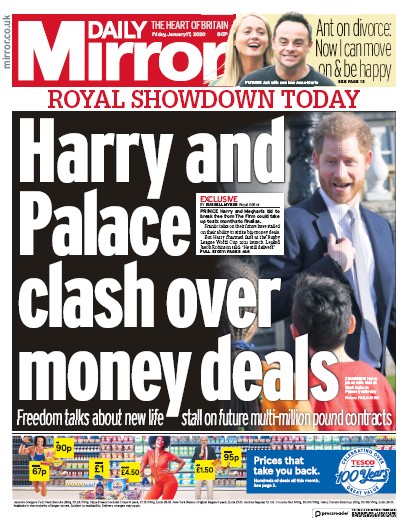
The political associations of a newspaper will affect how they present particular stories and in turn will influence what their readers think and believe. YouGov conducted a survey into readers’ perceptions of the political leaning of specific newspapers. Out of eight newspapers, five were seen to be predominantly right wing and two, including the Daily Mirror were perceived to be centre to left wing.
For the Daily Mirror, 76% of those asked thought it was to the left of centre, 11% thought it was ‘very left wing’, second to the Guardian in being the most left wing. The Daily Mail was perceived to be the most right wing newspaper. As this is the best selling daily newspaper, it may be influential in how their readers perceive events and issues.
Newspapers & Technology Change
Newspapers have had to adapt to changes in technology and the needs of their readers. All national and many local newspapers now have an online presence and their news content is also available on other social media platforms and through apps. This allows newspapers to broaden their audience reach in terms of production, distribution and circulation.
Just like the magazine industry, the newspaper industry is facing a drop in circulation figures as the readership diminishes. This reflects sociological changes related to the ways in which readers want to access their news. With advances in digital technology, news can be more immediate and a new generation of consumers who are used to receiving information in bite sized chunks, are much less likely to pick up a newspaper.
Newspapers have downsized and begun to produce online versions in order to target a new audience.
The digital revolution has also had an impact on how news is gathered. Frequently, news channels use citizen journalism, information from the general public rather than their own journalists, as the advances in technology mean that they now have the means to record images and send information immediately. This is particularly true when the story is unexpected such as a terrorist attack.
Online Newspaper
Advantages
They are immediate and up to date. When something happens users can access the news and get regular updates.
They offer more immediate interactive opportunities, for example, there is access to audio visual clips and opportunities to blog their opinions. The Daily Mail, which has a high percentage of female readers, has had particular success with its online version of ‘Femail’ with its diet of fashion and gossip.
Apps for several newspapers are available for mobile phones and ipads.
Archive facilities so that readers can access back issues.
The navigation tool allows users to quickly select the news and features that interest them.
News Values
News values are the criteria that will influence the decisions made by those who run the newspaper industry, including the owners, editors and journalists, about which stories will appear in their newspaper. These decisions are made everyday by gatekeepers who decide how the news is selected and constructed for the audience.
News Terminology
Threshold: the bigger the story the more likely it is to get onto the news agenda.
Negativity: bad news is more exciting and interesting than good news.
Unexpectedness: an event that is a shock or out of the ordinary for example ‘Lockdown’ of ‘Brexit’. These types of events will push other news stories off the news agenda and changes to the front page may be made at the last minute.
Unambiguity: events that are easy to report and not too complex will be higher up the agenda of some newspapers. Modern wars are often too difficult and are avoided by tabloid newspapers.
Personalisation: News stories that have a human interest angle are more likely to appear in some newspapers. Readers are interested in celebrities, and news stories have more meaning if they are personalised.
Proximity: The closer to home the story is, the more interested the reader. Tabloid and local newspapers tend to be more ethnocentric than quality newspapers.
Elite nations/People: stories about important people and powerful nations for example the USA will be further up the news agenda.
Continuity/currency: Stories that are already in the news continue to run and are updated as new aspects of the story appear. For example Donald trump.
Newspaper: Industry
The newspaper industry used to be regulated by the Press Complaints Commission (PCC). However, the PCC was severely criticised in the Leveson Inquiry conducted by Lord Leveson, which in 2012 investigated the culture, practice and ethics of the British press in the light of the phone hacking scandal and other issues related to the intrusion of privacy by the press. The PCC was seen to be ineffectual in regulating the newspaper industry.
Lord Leveson recommended for a new regulatory to replace the PCC.
The Leveson Inquiry
He also stated that there would be further sanctions for those newspapers that were deemed to have broken the law, including substantial fines. Newspapers at the time were concerned that this would be set up by Royal Charter and therefore the self regulatory system would be governed by legislation. The press industry was unhappy about these regulations becoming a legal requirement.
Those against the reform wanted newspapers to still have some regarding self regulation in order to protect the freedom of the press.
IPSO
The new regulatory body is the Independent Press Standards Organisation (IPSO), whose stated aim is to uphold professional standards in journalism. The role of IPSO involves:
- The regulation of over 1500 print and 1100 online titles.
- Dealing with complaints about possible breaches of the Editors Code of Practice.
- Giving help with unwanted press attention or harassment issues.
- Giving advice to to editors and journalists.
Key Theories
Curran and Seaton: Power and Media Industries
The main points of this theory are:
- Media producers are controlled by a small number of companies primarily driven by the logic of profit and power.
- The idea that media concentration generally limits or inhibits variety, creativity and quality.
- The idea that more socially diverse patterns of ownership help to create the conditions for more varied and adventurous patterns of ownership.
Consider this theory and how you would use it to analyse the set radio product, Including:
- The importance of the BBC as a major deliver or radio and television programmes.
- The role of the BBC as a public service broadcaster and its freedom from commercial pressures. The scope to target niche and diverse audiences of which LNWH is a good example.
- The ethos of the BBC and its values.
- The idea that BBC stations and channels have distinct styles and appeal to different audiences.
Stuart Hall: Reception Theory
Hall asserted that communication is a process involving encoding by producers and decoding by audiences. He said that there are three ways in which messages and meanings may be decoded by audiences.
- The dominant position: the audience accepts the intended meaning of the encoded in the product.
- The negotiated reading: the audience acknowledges some of the messages encoded by the producers of the product but may question or adapt the message to be more relatable to their own experiences.
- The oppositional reading: the encoder’s message is understood, but the decoder disagrees with it.
George Gerbner: Cultivation Theory
The work of Gerbner explores the way in which the media can influence people’s perceptions of social reality. The main principles of cultivation theory are:
- The idea that exposure to repeated patterns of representation over long periods of time can shape and influence the way in which people perceive the world around them. (i.e. cultivating particular views and opinions)
- The idea that cultivation reinforces mainstream values. (dominant ideologies)
























 Chloe Nottage Media